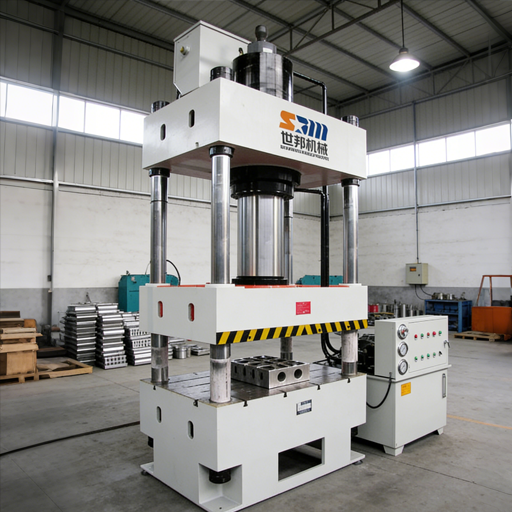
In the era of Industry 4.0, the traditional hydraulic press is undergoing a radical transformation. As global energy costs rise and ESG (Environmental, Social, and Governance) mandates tighten, manufacturers are pivoting toward Servo-Driven Hydraulic Systems.
This technical guide explores how energy recovery and intelligent energy management are redefining the efficiency of modern hydraulic cylinders and press frames.
Beyond Valve Control: The Rise of Servo-Pump Technology
For decades, the industry relied on proportional valves to throttle flow—a process that inherently generates heat and wastes electricity. The shift to Servo-Pump Control (SPC) has changed the game.
The SPC Advantage:
- Volumetric Control: Instead of wasting energy against a closed valve, the servo motor only rotates the pump at the exact speed required for the current task.
- Precision Specs: Advanced systems now achieve ±0.01mm positioning accuracy and ±1% pressure repeatability, even within the demanding 1–25 MPa range.
- Heat Reduction: By eliminating high-pressure overflow, the cooling requirements for hydraulic oil are reduced by up to 60%, extending the lifespan of heavy-duty hydraulic seals and cylinders.
Pro Tip: When selecting a servo hydraulic system, ensure the control algorithm includes Active Pressure Compensation to account for oil compressibility and thermal expansion.
Energy Efficiency: A Comparative Analysis
To understand the leap in performance, we must compare the energy logic of traditional machines versus modern servo-driven systems.
Traditional Hydraulic Systems: The Cost of Heat
In conventional setups, the pump runs at a constant speed, and excess flow is diverted through relief valves. This results in system efficiencies often hovering between 30% and 50%. During the downstroke, potential energy is completely dissipated via counterbalance valves, while the massive energy stored during high-pressure cycles is lost as waste heat during decompression. This necessitates oversized heat exchangers and high cooling energy consumption.
Servo-Driven Systems: Intelligence in Motion
In contrast, Servo Hydraulic Presses achieve overall efficiencies of 70% to 90%. By utilizing the motor’s ability to act as a generator, the potential energy of the descending ram is captured rather than suppressed. Furthermore, the system remains nearly idle during dwell times, consuming minimal power. This "Power-on-Demand" philosophy drastically reduces the thermal load, often allowing for passive cooling or significantly smaller, more cost-effective cooling units.
The Three Pillars of Energy Recovery
A "Smart" press treats energy as a recyclable asset. To maximize ROI, modern systems focus on three specific recovery vectors:
- Electrical Regeneration: The servo motor acts as a generator during the ram’s gravity-assisted descent or rapid deceleration, feeding electricity back into the common DC bus.
- Hydraulic Accumulators: Specialized circuits store the "surge" energy released during cylinder decompression, which is then re-routed to assist in the subsequent high-speed approach phase.
- Kinetic Braking: Capturing rotational inertia during high-frequency cycles to reduce the overall peak power draw from the grid.
Intelligent Energy Management (IEMS): Solving the "Peak Load" Crisis
Large-scale hydraulic equipment is notorious for Peak Power Spikes. These spikes lead to expensive "Demand Charges" from utility providers and stress on the factory's electrical infrastructure.
IEMS (Intelligent Energy Management Systems) act as a buffer. By utilizing Supercapacitors or Integrated Energy Storage, the system "shaves" the peaks of power consumption:
- Load Smoothing: Balancing the high-tonnage demand of the press stroke with the idle time between cycles.
- Grid Stability: Preventing voltage drops that could affect sensitive electronic equipment in the same facility.
- Data-Driven Insights: Real-time energy monitoring allows plant managers to calculate the exact energy cost per part.
Control Architecture: Why IPC is the New Industry Standard
While PLCs remain the backbone of simple automation, the computational demands of high-speed closed-loop hydraulic control have surpassed their limits.
Industrial PC (IPC) platforms are now the preferred choice for high-end servo presses:
- High-Speed Fieldbus: Utilizing EtherCAT for sub-millisecond synchronization between the servo drive and pressure sensors.
- Complex Motion Profiles: Enabling non-linear, multi-step pressing cycles that are impossible to program in standard ladder logic.
- Digital Twin Readiness: IPCs provide the processing power needed to run real-time simulations and predictive maintenance for hydraulic cylinder health monitoring.
A Strategic Investment in Efficiency
The transition to Servo Hydraulic Technology is a strategic move to lower the Total Cost of Ownership (TCO) and increase production quality. For manufacturers of hydraulic cylinders and systems, these innovations represent a critical opportunity to provide high-value, high-efficiency solutions to a global clientele.
Optimize Your Production with Advanced Hydraulics
Are you looking to retrofit your existing fleet or design a next-generation servo press?


