SPMT Hydraulic Suspension Cylinders | Lifting Leveling
How hydraulic suspension cylinders lift and level self-propelled modular transporters (SPMTs): working principle, suspension modes and design requirements — plus custom cylinder manufacturing from Shellppon.
2026/11/20
Reading volume: 0
News Details
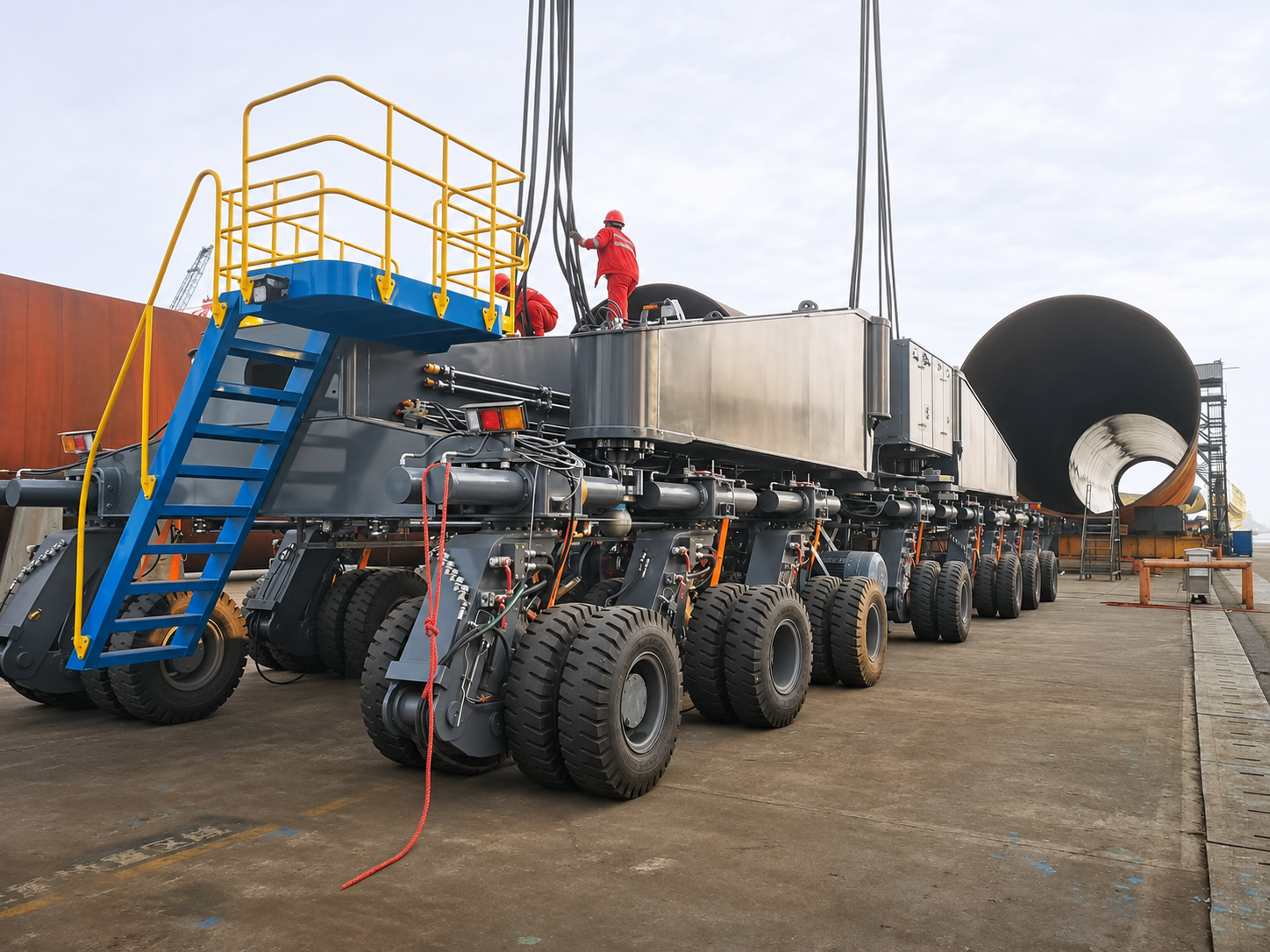
A self-propelled modular transporter (SPMT) moves heavy loads such as bridge spans, refinery modules and ship sections. Its hydraulic suspension cylinders let the operator raise the deck, adjust its height and lower the load onto supports. When the cargo and supports provide enough clearance, the transporter can pick up and set down the load without a separate crane.
Wuxi Shibang Machinery Manufacture Co., Ltd. (Shellppon) makes custom hydraulic cylinders for heavy lifting and transport equipment. Applications include suspension, lifting and positioning on modular transporter platforms.
How SPMT Hydraulic Suspension Works
An SPMT uses hydraulic cylinders to adjust the height of its axle lines relative to the deck. A power pack unit supplies pressurised oil to the suspension circuit. As the cylinders extend or retract, the suspension moves and changes the deck height.
The cylinders work with pendular axle assemblies, which allow the wheels to follow changes in the ground. The available deck travel depends on the cylinder stroke and the suspension geometry. On many platforms, the deck can move several hundred millimetres between its lowest and highest positions.
Many SPMTs link cylinders in hydraulic groups. A typical configuration uses three or four support points, with each point serving a group of axle lines. When a wheel climbs over a bump or drops into a dip, the connected cylinders can move relative to one another. This helps share the load within the group as the wheels follow the ground.
The total load on each group also depends on where the cargo sits. For example, a module with a centre of gravity near one end can place more weight on the axle lines beneath that end. Operators account for this weight distribution when planning how to support and move the load.
How the Suspension Helps With Lifting and Leveling
Picking up a load. The operator lowers the deck and moves the transporter into position beneath the cargo. The cylinders then raise the deck until it takes the weight from the supports. The required lift depends on the height of the supports and the clearance needed to move away.
Travelling with a load. The suspension allows the wheels to follow changes in the ground while supporting the cargo. When the transporter crosses a ramp, the operator may need to adjust the deck height or angle within the platform’s operating limits. The available adjustments depend on the transporter and its controls.
Setting down a load. At the destination, the operator positions the cargo over its new supports and lowers the deck in a controlled manner. Once the supports take the full weight and the deck has enough clearance, the transporter can drive out.
Control functions vary by model. Some systems display hydraulic pressure and deck height on a remote console. The operator can use these readings to monitor the lift and adjust the suspension as needed.
What an SPMT Suspension Cylinder Must Withstand
SPMT cylinders support heavy loads and handle frequent changes in force as the transporter moves. A cylinder design must suit the loads, mounting arrangement and working conditions of the specific platform.
- Load and pressure. The cylinder must generate enough force to lift the cargo at the available hydraulic pressure. The required force depends on the axle load, suspension geometry and operating conditions.
- Movement at the mounting points. The axle assembly changes angle as it follows uneven ground. If the design calls for a spherical rod end, the joint allows the cylinder to pivot and helps limit side loads on the rod.
- Repeated shocks. Uneven surfaces can cause short spikes in force. The rod, barrel and mounts must withstand these changes over repeated lifting and transport cycles.
- Seal performance. The seals must suit the hydraulic fluid and the expected temperature range. The amount of movement and the condition of the rod surface also affect seal wear.
- Corrosion resistance. Outdoor, coastal and industrial sites can expose the cylinder to rain, salt or other contaminants. Rod finishes and external coatings should suit the environment.
- Load holding. The cylinder works as part of the suspension circuit. The machine designer selects the valves and circuit layout that control movement and help hold the load if pressure drops.
What to Include in a Custom Cylinder Enquiry
Start with the cylinder drawing or the dimensions of the available mounting space. Include the required stroke, retracted and extended lengths, mounting pin sizes, and hydraulic port locations. These details help the manufacturer check whether the cylinder will fit and move through its full range.
Share the working pressure, maximum expected load, hydraulic fluid and operating temperature range. If the cylinder will work outdoors or near the coast, describe the expected exposure to water, dirt or salt. Mention any need for cushioning near the end of the stroke or for a sensor that reports rod position.
For a replacement cylinder, include the existing part number, drawing or clear photos of the mounts and ports, if available. Note any fit or performance problems you want the replacement to address.
Custom SPMT Hydraulic Cylinders from Shellppon
Shellppon manufactures hydraulic cylinders in Wuxi, Jiangsu. The company has more than 20 years of experience and operates a facility of over 7,000 m² under an ISO 9001 quality management system. Its catalogue includes cylinders for engineering equipment, vehicles and metallurgical machinery.
For modular transport projects, Shellppon can manufacture custom suspension, lifting and positioning cylinders from customer drawings. Options include spherical rod ends, end-of-stroke cushioning, position sensors and seals selected to match the hydraulic fluid and operating temperature.
To request a dimensional drawing or quote for an SPMT hydraulic suspension cylinder, share your application details with Shellppon.
Share to:


